.svg)


You can build muscle at home without a wall of machines, a crowded weight room, or a complicated workout split that takes over your week. Your muscles respond to tension, effort, and progression. A pair of dumbbells, a resistance band, or your own bodyweight can provide all three when you train with a clear plan.
That message is especially relevant now. The American College of Sports Medicine’s 2026 resistance-training guidance recognizes bodyweight exercises, elastic bands, and home-based routines as effective ways to improve strength and muscle growth. The guidance also keeps the main priority refreshingly simple: train consistently, work the major muscle groups, and match your weekly training volume to your goal.
For busy women, that creates a lot of freedom. You can get stronger in a spare room before the day begins, finish a focused session while dinner is in the oven, or keep your routine moving during a packed season. The location matters far less than the quality of the work you repeat.
What Actually Makes a Muscle Grow?
Muscle growth, also called hypertrophy, happens when your training gives the body a reason to adapt and your nutrition and recovery provide the resources for that adaptation. The process takes time. Each workout is a signal; the weeks and months of repeated signals create visible change.
Four parts of the process deserve your attention:
- Meaningful resistance. The target muscle needs to work against a challenging load. That load may come from a dumbbell, a band, a backpack, gravity, or a more demanding bodyweight position.
- Enough effort. The final few repetitions of a working set should feel slow and challenging while your form stays steady. You do not need to reach complete failure on every set. Finishing with roughly one to three good repetitions still available is a practical target for many exercises.
- Progress over time. Your body adapts to familiar work. Continuing to grow requires a gradual increase in repetitions, resistance, range of motion, control, sets, or exercise difficulty.
- Fuel and recovery. Protein supplies amino acids that support muscle repair. Total food intake, carbohydrates, sleep, and rest days also influence how well you train and recover.
Home training works when these pieces are present. Random movement can feel productive in the moment, but a repeatable plan makes progress easier to see and manage.
The Best At-Home Equipment for Building Muscle
You can begin with what you have and expand only when a new tool would make progression easier. A simple equipment ladder keeps the decision practical.
Level 1: Bodyweight and Household Items
Start with a stable chair or bench, a wall, a towel, and a backpack that can hold books or water bottles. These tools support squats, split squats, push-up variations, hip thrusts, rows, carries, and core work.
Check that furniture is sturdy and that the backpack closes securely before you train.
Level 2: A Long Resistance Band
A band adds pulling options that can be difficult to reproduce with bodyweight alone. It works well for rows, pulldowns, pull-aparts, presses, hinges, and glute exercises.
A door anchor expands your options, provided it is installed exactly as directed and the door closes securely away from you.
Level 3: Adjustable or Multiple Dumbbells
Dumbbells make load progression straightforward. Ideally, choose enough range for both upper- and lower-body training.
Your legs and glutes can typically handle more resistance than your shoulders and arms, so one very light pair may become limiting quickly. Adjustable dumbbells save space and let you increase weight in smaller steps.
A mat can add comfort, and a sturdy step or bench can create more exercise options. Everything else is optional. Build your home setup around the movements you perform consistently.
Choose Exercises That Cover the Whole Body
An effective home workout for muscle growth should cover a handful of foundational movement patterns. You do not need dozens of exercises. You need reliable movements that you can perform well and progress over time.
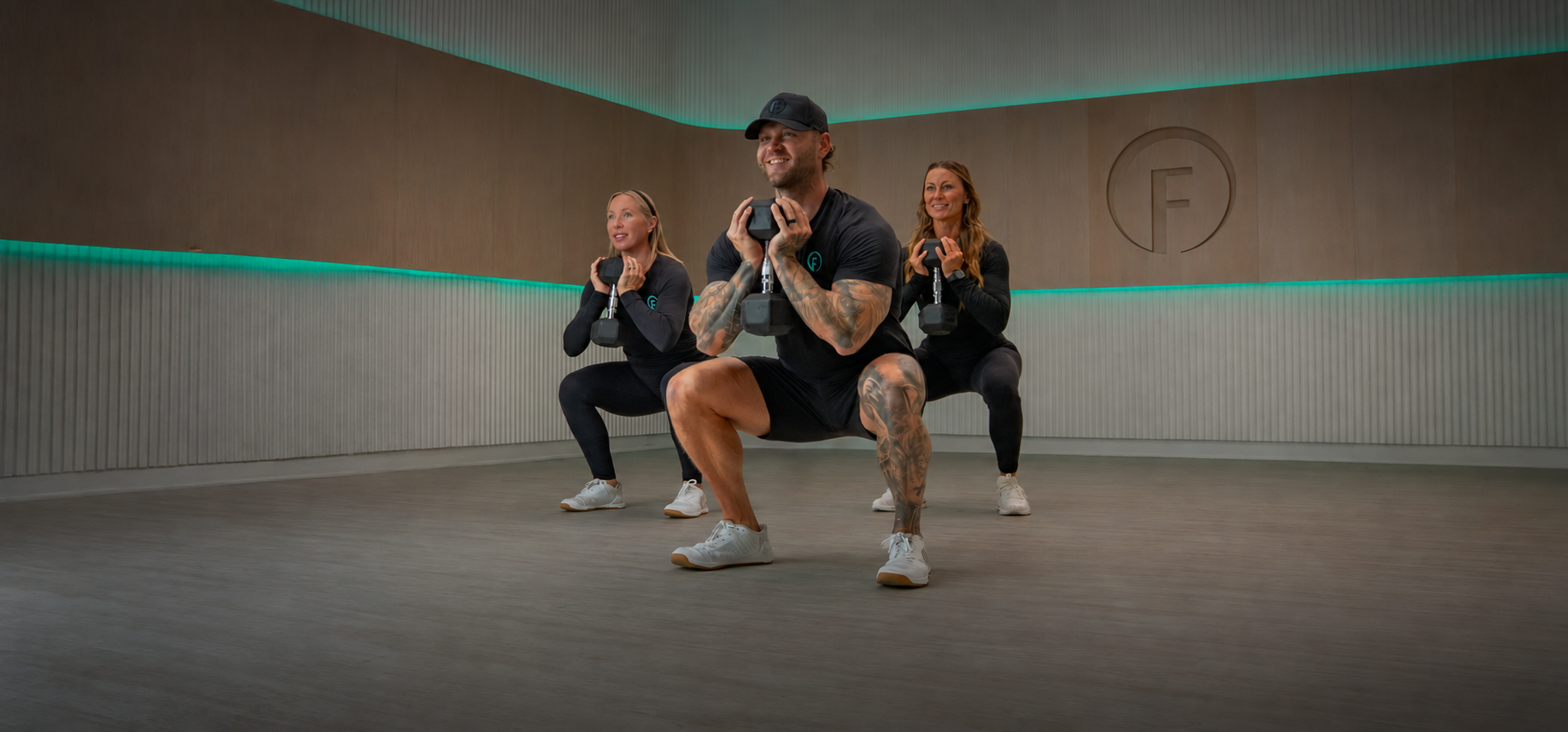
- Squat or lunge: Goblet squat, chair squat, reverse lunge, split squat, or step-up.
- Hip hinge or glute pattern: Romanian deadlift, banded good morning, hip thrust, or glute bridge.
- Horizontal push: Floor press, incline push-up, or standard push-up.
- Horizontal or vertical pull: One-arm dumbbell row, band row, band pulldown, or backpack row.
- Vertical push: Dumbbell overhead press, half-kneeling press, or band press.
- Core and carry: Dead bug, side plank, suitcase carry, or farmer carry.
These patterns train the major muscle groups and give you enough variety to keep your joints comfortable.
If one movement causes sharp pain or feels unstable, stop and choose a comfortable alternative. A qualified fitness or healthcare professional can help when pain persists or you are returning after an injury.

Subscribe to our blog
Lorem ipsum dolor sit amet, consectetur adipiscing elit. Suspendisse varius enim in eros elementum tristique.
.png)
You can build muscle at home without a wall of machines, a crowded weight room, or a complicated workout split that takes over your week. Your muscles respond to tension, effort, and progression. A pair of dumbbells, a resistance band, or your own bodyweight can provide all three when you train with a clear plan.
That message is especially relevant now. The American College of Sports Medicine’s 2026 resistance-training guidance recognizes bodyweight exercises, elastic bands, and home-based routines as effective ways to improve strength and muscle growth. The guidance also keeps the main priority refreshingly simple: train consistently, work the major muscle groups, and match your weekly training volume to your goal.
For busy women, that creates a lot of freedom. You can get stronger in a spare room before the day begins, finish a focused session while dinner is in the oven, or keep your routine moving during a packed season. The location matters far less than the quality of the work you repeat.
What Actually Makes a Muscle Grow?
Muscle growth, also called hypertrophy, happens when your training gives the body a reason to adapt and your nutrition and recovery provide the resources for that adaptation. The process takes time. Each workout is a signal; the weeks and months of repeated signals create visible change.
Four parts of the process deserve your attention:
- Meaningful resistance. The target muscle needs to work against a challenging load. That load may come from a dumbbell, a band, a backpack, gravity, or a more demanding bodyweight position.
- Enough effort. The final few repetitions of a working set should feel slow and challenging while your form stays steady. You do not need to reach complete failure on every set. Finishing with roughly one to three good repetitions still available is a practical target for many exercises.
- Progress over time. Your body adapts to familiar work. Continuing to grow requires a gradual increase in repetitions, resistance, range of motion, control, sets, or exercise difficulty.
- Fuel and recovery. Protein supplies amino acids that support muscle repair. Total food intake, carbohydrates, sleep, and rest days also influence how well you train and recover.
Home training works when these pieces are present. Random movement can feel productive in the moment, but a repeatable plan makes progress easier to see and manage.
The Best At-Home Equipment for Building Muscle
You can begin with what you have and expand only when a new tool would make progression easier. A simple equipment ladder keeps the decision practical.
Level 1: Bodyweight and Household Items
Start with a stable chair or bench, a wall, a towel, and a backpack that can hold books or water bottles. These tools support squats, split squats, push-up variations, hip thrusts, rows, carries, and core work.
Check that furniture is sturdy and that the backpack closes securely before you train.
Level 2: A Long Resistance Band
A band adds pulling options that can be difficult to reproduce with bodyweight alone. It works well for rows, pulldowns, pull-aparts, presses, hinges, and glute exercises.
A door anchor expands your options, provided it is installed exactly as directed and the door closes securely away from you.
Level 3: Adjustable or Multiple Dumbbells
Dumbbells make load progression straightforward. Ideally, choose enough range for both upper- and lower-body training.
Your legs and glutes can typically handle more resistance than your shoulders and arms, so one very light pair may become limiting quickly. Adjustable dumbbells save space and let you increase weight in smaller steps.
A mat can add comfort, and a sturdy step or bench can create more exercise options. Everything else is optional. Build your home setup around the movements you perform consistently.
Choose Exercises That Cover the Whole Body
An effective home workout for muscle growth should cover a handful of foundational movement patterns. You do not need dozens of exercises. You need reliable movements that you can perform well and progress over time.
- Squat or lunge: Goblet squat, chair squat, reverse lunge, split squat, or step-up.
- Hip hinge or glute pattern: Romanian deadlift, banded good morning, hip thrust, or glute bridge.
- Horizontal push: Floor press, incline push-up, or standard push-up.
- Horizontal or vertical pull: One-arm dumbbell row, band row, band pulldown, or backpack row.
- Vertical push: Dumbbell overhead press, half-kneeling press, or band press.
- Core and carry: Dead bug, side plank, suitcase carry, or farmer carry.
These patterns train the major muscle groups and give you enough variety to keep your joints comfortable.
If one movement causes sharp pain or feels unstable, stop and choose a comfortable alternative. A qualified fitness or healthcare professional can help when pain persists or you are returning after an injury.
Subscribe to our blog
Lorem ipsum dolor sit amet, consectetur adipiscing elit. Suspendisse varius enim in eros elementum tristique.
How to Build Muscle at Home: A Simple Strength Plan That Gets Results
You can build muscle at home without a wall of machines, a crowded weight room, or a complicated workout split that takes over your week. Your muscles respond to tension, effort, and progression. A pair of dumbbells, a resistance band, or your own bodyweight can provide all three when you train with a clear plan.
That message is especially relevant now. The American College of Sports Medicine’s 2026 resistance-training guidance recognizes bodyweight exercises, elastic bands, and home-based routines as effective ways to improve strength and muscle growth. The guidance also keeps the main priority refreshingly simple: train consistently, work the major muscle groups, and match your weekly training volume to your goal.
For busy women, that creates a lot of freedom. You can get stronger in a spare room before the day begins, finish a focused session while dinner is in the oven, or keep your routine moving during a packed season. The location matters far less than the quality of the work you repeat.
What Actually Makes a Muscle Grow?
Muscle growth, also called hypertrophy, happens when your training gives the body a reason to adapt and your nutrition and recovery provide the resources for that adaptation. The process takes time. Each workout is a signal; the weeks and months of repeated signals create visible change.
Four parts of the process deserve your attention:
- Meaningful resistance. The target muscle needs to work against a challenging load. That load may come from a dumbbell, a band, a backpack, gravity, or a more demanding bodyweight position.
- Enough effort. The final few repetitions of a working set should feel slow and challenging while your form stays steady. You do not need to reach complete failure on every set. Finishing with roughly one to three good repetitions still available is a practical target for many exercises.
- Progress over time. Your body adapts to familiar work. Continuing to grow requires a gradual increase in repetitions, resistance, range of motion, control, sets, or exercise difficulty.
- Fuel and recovery. Protein supplies amino acids that support muscle repair. Total food intake, carbohydrates, sleep, and rest days also influence how well you train and recover.
Home training works when these pieces are present. Random movement can feel productive in the moment, but a repeatable plan makes progress easier to see and manage.
The Best At-Home Equipment for Building Muscle
You can begin with what you have and expand only when a new tool would make progression easier. A simple equipment ladder keeps the decision practical.
Level 1: Bodyweight and Household Items
Start with a stable chair or bench, a wall, a towel, and a backpack that can hold books or water bottles. These tools support squats, split squats, push-up variations, hip thrusts, rows, carries, and core work.
Check that furniture is sturdy and that the backpack closes securely before you train.
Level 2: A Long Resistance Band
A band adds pulling options that can be difficult to reproduce with bodyweight alone. It works well for rows, pulldowns, pull-aparts, presses, hinges, and glute exercises.
A door anchor expands your options, provided it is installed exactly as directed and the door closes securely away from you.
Level 3: Adjustable or Multiple Dumbbells
Dumbbells make load progression straightforward. Ideally, choose enough range for both upper- and lower-body training.
Your legs and glutes can typically handle more resistance than your shoulders and arms, so one very light pair may become limiting quickly. Adjustable dumbbells save space and let you increase weight in smaller steps.
A mat can add comfort, and a sturdy step or bench can create more exercise options. Everything else is optional. Build your home setup around the movements you perform consistently.
Choose Exercises That Cover the Whole Body
An effective home workout for muscle growth should cover a handful of foundational movement patterns. You do not need dozens of exercises. You need reliable movements that you can perform well and progress over time.
- Squat or lunge: Goblet squat, chair squat, reverse lunge, split squat, or step-up.
- Hip hinge or glute pattern: Romanian deadlift, banded good morning, hip thrust, or glute bridge.
- Horizontal push: Floor press, incline push-up, or standard push-up.
- Horizontal or vertical pull: One-arm dumbbell row, band row, band pulldown, or backpack row.
- Vertical push: Dumbbell overhead press, half-kneeling press, or band press.
- Core and carry: Dead bug, side plank, suitcase carry, or farmer carry.
These patterns train the major muscle groups and give you enough variety to keep your joints comfortable.
If one movement causes sharp pain or feels unstable, stop and choose a comfortable alternative. A qualified fitness or healthcare professional can help when pain persists or you are returning after an injury.
.png)
The FASTer Way Program is an all-in-one solution that takes the guesswork out of building muscle and burning fat:•Daily Strength Training Workouts (30 minutes or less)
•Weekly Fat-Burning, Hormone Supportive Meal Guides
•Access to the Clinically Proven FASTer Way App
•Coaching, Accountability + Progress Tracking
A Simple Three-Day Home Strength Plan
Train on three nonconsecutive days when possible, such as Monday, Wednesday, and Friday. Each session can fit into about 30 minutes.
Begin with two working sets per exercise during your first two weeks. Move toward three sets as the routine feels more familiar and your recovery remains solid.
Workout A: Squat, Push, and Pull
- Goblet squat or backpack squat: 2–3 sets of 8–15 repetitions
- Dumbbell floor press or incline push-up: 2–3 sets of 8–15 repetitions
- One-arm dumbbell or backpack row: 2–3 sets of 10–15 repetitions per side
- Romanian deadlift: 2–3 sets of 8–15 repetitions
- Dead bug: 2–3 sets of 6–10 controlled repetitions per side
Workout B: Single-Leg Strength and Shoulders
- Reverse lunge or supported split squat: 2–3 sets of 8–12 repetitions per side
- Dumbbell or band overhead press: 2–3 sets of 8–15 repetitions
- Band pulldown or band row: 2–3 sets of 10–20 repetitions
- Hip thrust or glute bridge: 2–3 sets of 10–20 repetitions
- Suitcase carry or side plank: 2–3 rounds per side
Workout C: Full-Body Progression
- Step-up or tempo chair squat: 2–3 sets of 8–15 repetitions per side
- Push-up variation or dumbbell floor press: 2–3 sets of 8–15 repetitions
- One-arm row: 2–3 sets of 10–15 repetitions per side
- Single-leg Romanian deadlift or staggered-stance hinge: 2–3 sets of 8–12 repetitions per side
- Farmer carry or plank: 2–3 rounds
Rest for about 60–120 seconds between challenging sets. Longer rest can help you maintain strong form and performance on squats, hinges, presses, and rows.
If time is tight, pair movements that train different areas, such as a squat with a row, and rest after both exercises.
How Hard Should Each Set Feel?
A repetition range is useful only when the load makes that range challenging.
If you finish 15 squats and could immediately complete 15 more, the set probably needs more resistance or a harder variation. If your form changes after five repetitions, reduce the load or choose an easier version.
Use the “repetitions in reserve” method as a simple effort check. Most working sets can end when you believe you could complete one to three additional clean repetitions.
Research does not show that complete muscular failure is required for growth, and stopping slightly short often supports better technique and recovery. With lighter resistance, you may need to work closer to your limit to make the set challenging.
Your final repetitions may move more slowly. They should still look like the exercise you started. A shortened range, bouncing, twisting, or losing control are signs to finish the set.
Progressive Overload at Home: Your Growth Engine
Progressive overload sounds technical, but the practice is simple: ask your muscles to do a little more over time.
Home training gives you several ways to progress even when your equipment stays the same.
- Add repetitions within the planned range.
- Increase the dumbbell weight or use a stronger band.
- Add a working set.
- Increase your comfortable range of motion.
- Use a harder exercise variation.
- Lower the weight for two to three seconds.
- Add a brief pause in a stable position.
- Improve your control and technique.
A double-progression system makes this easy to track.
Suppose your goal is three sets of 8–12 dumbbell rows. Keep the same weight until you can complete 12 clean repetitions across all three sets with about two repetitions in reserve. Then increase the weight and begin near eight repetitions again.
That small loop can guide months of progress.
How Much Weekly Training Do You Need?
The 2026 ACSM guidance highlights roughly 10 weekly sets per muscle group as a useful target when muscle growth is the priority. That number is a destination, not an entry requirement.
Beginners often respond well to less, especially when the sets are new and challenging.
Start with two full-body sessions if three feels unrealistic. Complete two sets for each major movement pattern and build the habit. A third day or additional set can come later.
More work helps only when you can recover from it and continue progressing. Your best weekly volume is the amount you can perform with good effort, repeat consistently, and support with sleep and food.
Training each major muscle group at least twice per week is a practical rhythm. Full-body workouts make that frequency easy at home and remove the pressure to fit long, separate upper- and lower-body sessions into your calendar.
Eat to Support Muscle Growth
Training starts the conversation with your muscles; nutrition helps carry it forward.
Include a meaningful protein source at meals and consider a protein-rich snack when your meals are spread far apart. Eggs, Greek-style yogurt, cottage cheese, fish, poultry, lean meat, tofu, tempeh, edamame, beans, lentils, and protein powder can all contribute.
A practical meal template pairs protein with produce, a satisfying carbohydrate, and a source of healthy fat.
Strength days are a smart time to include carbohydrates such as oats, rice, potatoes, fruit, or whole grains because they support training energy and help replenish muscle glycogen.
Hydration matters, too, especially when you train in a warm room or sweat heavily.
Muscle gain is harder when you are chronically under-fueled. A very aggressive calorie deficit may reduce training quality and make recovery more difficult.
If fat loss is also a goal, a moderate, sustainable approach with consistent protein and strength training is typically more supportive of lean mass than repeated cycles of restriction.
Protein needs vary with body size, age, activity level, and training. A registered dietitian can help personalize an appropriate target, particularly if you have kidney disease, digestive concerns, food allergies, or other medical considerations.
Recovery Is Part of the Plan
Muscle tissue adapts between workouts. Give the same muscle groups time before another hard session, and aim for a steady sleep routine.
Light walking, mobility work, and normal daily activity can support recovery without adding another demanding workout.
Some muscle soreness is common when you begin a new routine, change exercises, or add volume. Soreness is not a scorecard for workout quality.
Track whether your repetitions, resistance, control, and confidence are improving. Those signals tell you more about the direction of your training.
Stress and busy schedules count as part of your recovery picture. On a demanding week, keep the exercises and complete fewer sets. A shorter session maintains the rhythm and makes it easier to return to normal volume when life settles down.
Common Home Muscle-Building Mistakes
Changing the Workout Every Day
Variety can be fun, but constant novelty makes progression difficult to measure. Keep your main exercises for four to eight weeks, then update movements that feel stale, uncomfortable, or difficult to progress.
Rushing Every Set
Speeding through repetitions can shift tension away from the target muscles and turn strength work into a conditioning session. Use a controlled range of motion and let challenging sets take the time they need.
Using Only the Lightest Weight
Light resistance can build muscle when the set becomes genuinely challenging. Many people stop because they reached an arbitrary repetition number rather than because the muscle was close to its current limit.
Let effort, form, and the available repetition range guide you.
Skipping Pulling Movements
Home plans often include plenty of squats and push-ups while missing work for the back. A band, dumbbell, or loaded backpack makes rows accessible.
Include at least as much thoughtful pulling as pressing across the week.
Expecting Immediate Visual Change
Strength can improve before muscle growth becomes easy to see. Give the plan enough time to work.
Progress photos, how your clothing fits, workout logs, energy, and daily function can provide a fuller view than the scale alone.
How to Start This Week
Choose two or three training days and place them on your calendar. Select one exercise for each major movement pattern. Record the resistance, repetitions, and sets you complete.
For your first week, finish each set with two or three solid repetitions available and focus on learning the movements. Next week, add one repetition where you can.
That is enough to begin.
Your home does not need to look like a gym, and your plan does not need to feel extreme. A few well-chosen movements, repeated with growing strength, can build lean muscle and confidence in a way that fits real life.
Keep showing up, keep a simple record, and give your body the consistent signal it needs to grow stronger.
This article provides general wellness education and is not individualized medical or exercise advice. Consult a qualified healthcare or fitness professional before beginning a new program if you are pregnant, managing a health condition, experiencing pain, or returning after an injury or extended break.
You Don't Have To Figure This Out Alone
If you're ready for more than a workout plan—real accountability, easy meal guides, expert coaching, a comprehensive app, and a community cheering you on—FASTer Way is ready when you are.